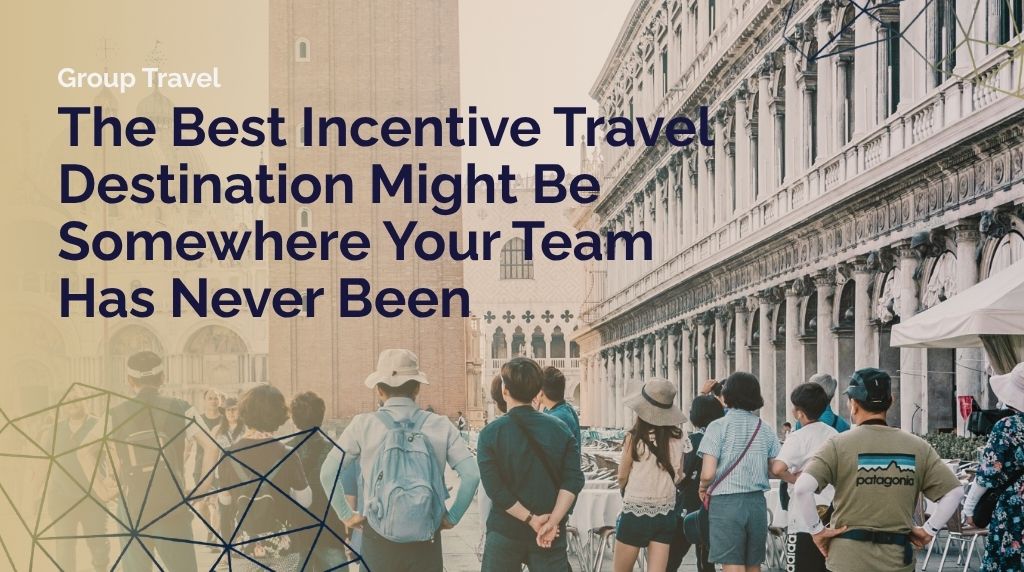

When planning a corporate reward trip, the list of potential incentive travel destinations often includes familiar, high-profile locales: the beaches of the Caribbean, the lights of Las Vegas, the history of Paris. These are popular for a reason, but a growing trend suggests that the most impactful destination might be one that isn’t on the usual shortlist. Recent research from the Incentive Travel Index, a partnership between the Society for Incentive Travel Excellence (SITE) and Radisson Hotels, highlights a significant shift in traveller preferences. Participants are increasingly drawn to novelty, culture, and the appeal of going ‘somewhere I haven’t been before.’ This pivot from the purely aspirational to the experiential presents a powerful opportunity for companies to design more memorable and meaningful reward programmes.
🧳 Organizing Group Travel?
Choosing a destination that is unfamiliar to most, if not all, of the participants changes the dynamic of an incentive trip. It moves the focus from individual luxury to shared discovery. While a five-star resort offers comfort, a destination that offers a genuine sense of place provides context, conversation, and a foundation for collective memories. The goal is no longer just to reward high performers with a beautiful backdrop, but to give them a story they can bring home—a story they created together. The challenge for planners is to find destinations that are both novel and desirable, balancing the thrill of the unknown with the practical logistics required for successful group travel.

“There's something really special about taking a group somewhere most of them haven't been before. Nobody arrives knowing all the best places or having already done everything. You're discovering it together, and I think that creates a completely different energy around the trip.”
For years, the value of incentive travel was often measured by a destination’s prestige. The trip was a ‘trophy’—a status symbol that top performers could talk about. While this model still has its place, many seasoned travellers and younger employees are motivated by different factors. They seek authenticity, cultural immersion, and unique experiences that they couldn’t easily replicate on their own. The value proposition is shifting from ‘where you stayed’ to ‘what you did’ and, more importantly, ‘how it made you feel.’ This evolution requires a more thoughtful approach to selecting incentive travel destinations, one that prioritizes discovery over familiarity.
Consider the social dynamics of a group trip. When a company chooses a familiar destination like Orlando or Cancun, it is almost certain that some participants have been there before—perhaps multiple times. They arrive with established opinions, favourite restaurants, and preconceived notions. They become informal guides, and the group naturally fractures into those who ‘know’ and those who don’t. In a less familiar destination, however, more participants are discovering the experience at roughly the same time. The dynamic shifts from, ‘I’ll show you where to go,’ to a more collaborative, ‘Should we see what’s over there?’ This shared vulnerability and curiosity can foster a powerful sense of unity.
At the office, participants arrive with their titles: CEO, director, sales lead, coordinator. Workplace hierarchy is an established reality. While an incentive trip doesn’t erase these structures, an unfamiliar environment can temporarily soften them. In a new city, facing a new language and new customs, everyone shares another identity: traveller. Put people somewhere unfamiliar and, for a little while, everyone gets to be new at something. This can create moments of connection and conversation that happen outside of normal workplace patterns, fostering relationships that persist long after the trip ends.
Memories are deeply personal, but shared experiences build collective identity. Someone revisiting Paris may bring years of previous memories with them, colouring their experience. But a team discovering Helsinki, Galle, or Auckland for the first time together will forever associate that place with the people they were with. The unexpected detour, the fantastic meal at a hidden restaurant, the boat ride that revealed a stunning view—these moments become ‘that time when we…’ stories. The most valuable souvenir from an incentive trip may be a story the team keeps telling after they get home.
To illustrate this principle, consider how the destination itself can shape the experience. These five locations show how novelty can be a powerful tool in programme design.
Novelty is relative to the group’s experience. For a Canadian company whose incentive travel has revolved around North American hubs, ‘somewhere new’ doesn’t have to be on the other side of the world. It could be Québec City, Newfoundland, Copenhagen, Scotland, or Oaxaca, Mexico. The principle is to choose somewhere that gives the group something meaningful to discover together, moving beyond the predictable to create a genuine sense of occasion.
A strong destination choice should heavily influence the itinerary. Ask: What can we do here that we couldn’t easily do somewhere else? The answer should guide your planning, incorporating local food, cultural traditions, unique landscapes, art, music, and local experts. If you could move the exact same itinerary to another country and nobody would notice, the destination probably isn’t doing enough work.
While the destination should feel special, the journey to get there shouldn’t be an ordeal. Obscure does not automatically mean better. Every potential destination must be vetted through a practical corporate travel lens. A professional Group Travel Management partner will evaluate critical factors like air access, flight times, safety, hotel inventory, ground transportation, and medical access. The destination should feel adventurous once you arrive, not exhausting before you get there. Keeping travellers organized is also key, which is where tools like our Tripscape App provide value by consolidating itineraries, but nothing replaces the expertise of a human advisor managing the complex logistics of moving a group.
Make novelty an intentional criterion in your selection process. Before defaulting to the usual suspects, survey your potential participants. Understanding their travel history can reveal opportunities to choose a destination that will be new and exciting for the vast majority of the group. This simple step can transform the trip from ‘another incentive’ into a once-in-a-lifetime experience.
To find the right balance, consider these key questions:
The sweet spot isn’t simply somewhere new. It’s somewhere new that feels worth discovering together.
Choosing an unfamiliar destination promotes shared discovery among participants, as few will have preconceived notions. This can foster stronger team bonding and create unique collective memories. While classic destinations offer prestige, new locations provide a sense of adventure and experiences that feel exclusive to the group, making the reward more memorable and personal.
Not at all. Novelty is relative to your team's travel history. If your group is accustomed to Caribbean or U.S. destinations, a trip to Québec City, Scotland, or Portugal could feel entirely new and exciting. The goal is to choose a location that offers a fresh perspective and opportunities for discovery, which doesn't necessarily mean long-haul flights or remote settings.
This is where professional travel management is critical. The ideal destination must be vetted for practical considerations like flight accessibility, safety, quality hotel inventory, and reliable ground transportation. The goal is an experience that feels adventurous upon arrival, not stressful during transit. A travel partner handles these logistics, allowing you to focus on the programme while ensuring traveller safety and comfort.
An incentive trip is fundamentally a reward to recognize and motivate top performers. The focus is on celebration, relaxation, and aspirational experiences. A corporate retreat, on the other hand, is designed to achieve a specific business objective, such as strategic planning, team building, or leadership development. While it can be held in a desirable location, the itinerary is built around work-related goals.
Traditional destinations remain popular for good reason—they are proven, reliable, and aspirational. But in a world where unique experiences are increasingly valued, companies shouldn’t overlook the power of the unexpected. The right partner can help you navigate the complexities of less-travelled destinations, ensuring the logistics are seamless so your team can focus on the discovery. The next unforgettable incentive trip might not begin with, ‘I’ve always wanted to go there.’ It might begin with, ‘I never would have thought of that.’ And that is often where the most powerful stories start.
💡 Need help planning business trips? Work with a corporate travel agency that gets it. Inspired Travel Group handles every detail with expert care. Get Started Today!
