
Inspired Travel Group is a full-service corporate travel agency servicing clients right the way across North America. Our people first approach to travel ensures only the highest levels of personalized, attentive service.
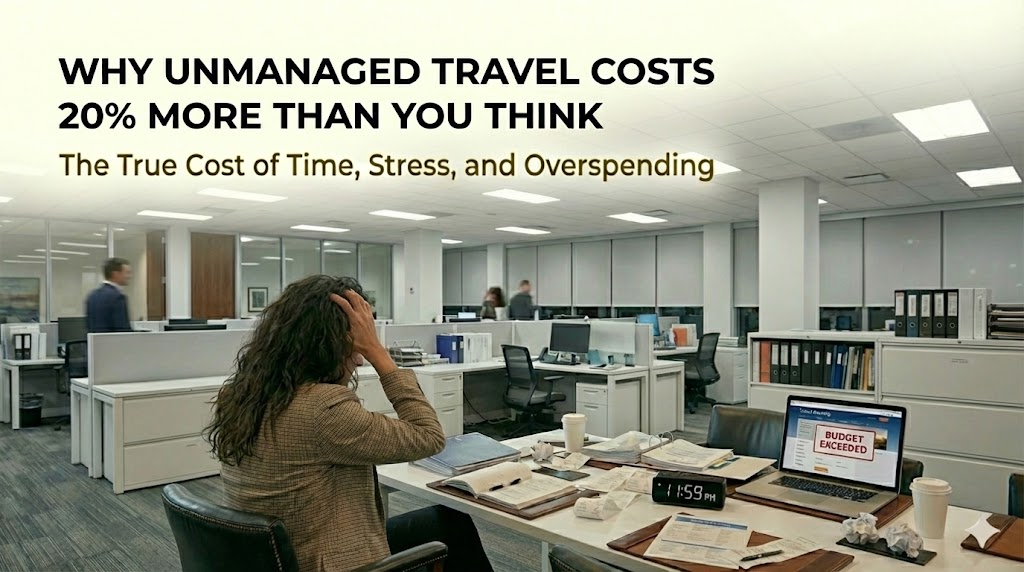
In the world of corporate finance, every expense line is scrutinized—except, it seems, the one disguised as a saving. The allure of ‘free’ online booking platforms has led many organizations to overlook the significant financial drain of an unmanaged travel programme. The reality is that these perceived savings are an illusion. The true unmanaged travel costs are buried in process inefficiencies, policy gaps, and missed opportunities, often inflating a company’s total travel spend by a staggering 20% or more.
This article moves beyond the surface-level ticket price to uncover the four critical areas where unmanaged business travel leaks revenue and exposes your organization to unnecessary risk.
💼 Want to Take the Stress Out of Business Travel?
👉 Get started with a dedicated corporate travel specialist today.
As corporate travel resumes its critical role in business growth, the complexity of managing it has intensified. Global business travel spending is projected to surpass its pre-pandemic high of $1.4 trillion in 2024, according to the Global Business Travel Association (GBTA). With this surge in volume comes a greater need for strategic oversight. Companies that treat travel as an unmanaged, ad-hoc expense are not simply missing out on savings; they are actively eroding their bottom line and neglecting their duty of care obligations to their most valuable asset: their people.
The belief that allowing employees to book their own travel on consumer websites saves money is a common but costly misconception. The sticker price of a flight or hotel is only one small component of the total cost of a trip. A professionally managed travel programme addresses the entire ecosystem of expenses, both direct and indirect.
Time is a non-renewable resource, and in business, it translates directly to cost. When executives or administrative staff spend hours searching for flights, comparing hotel options, or trying to resolve issues with a faceless online travel agency (OTA), they are not focusing on their core, revenue-generating responsibilities. Consider the following:
A managed travel programme centralizes this process with a dedicated advisor who handles all logistics in minutes, freeing your team to focus on what they do best.
Without a clear, enforceable travel policy, there is no framework for cost control. ‘Maverick spending’ occurs when employees book outside of company guidelines, often choosing convenience over cost-effectiveness. This can include:
Implementing a formal travel policy is the first step, but enforcement is key. Analysis from firms like McKinsey & Company consistently shows that disciplined spend management and policy compliance are fundamental drivers of significant corporate savings. A travel management company (TMC) acts as a neutral partner in enforcing this policy, guiding employees to compliant choices that align with the company’s financial goals.
Individual businesses lack the buying power to negotiate favourable rates with airlines, hotels, and car rental companies. A professional TMC aggregates the spending of all its clients to gain significant leverage. This translates into tangible savings and value that are inaccessible to the general public.
By partnering with a dedicated corporate travel agency in Canada, businesses can transform their travel spend from a simple expense into a strategic investment with measurable returns.
In today’s unpredictable world, knowing where your employees are is not just good practice—it’s a legal and moral obligation known as Duty of Care. When bookings are fragmented across dozens of different websites, a company has no central repository of traveller information. In an emergency—be it a natural disaster, a medical issue, or a geopolitical event—locating and assisting your team becomes a nearly impossible task. This exposes the company to significant liability and, more importantly, fails its people when they are most vulnerable. A managed programme ensures all travel data is centralized, allowing for instant location tracking and communication in a crisis.
Unmanaged travel allows employees to book their own business trips using public websites without policy oversight. Managed travel involves partnering with a travel management company (TMC) to centralize bookings, enforce policy, leverage negotiated rates, and ensure traveller safety. The primary difference is the shift from a reactive, fragmented process to a proactive, strategic one.
Pricing models vary. Some TMCs charge a percentage of spend, while others use a subscription or a per-transaction fee model. The key is to find a transparent structure where the cost is easily outweighed by the savings in time, direct expense reduction, and risk mitigation. Often, the savings generated through policy and efficiency pay for the programme itself.
While online booking tools (OBTs) can be a component of a managed programme, they are not a complete solution. An OBT cannot negotiate unique supplier contracts, provide expert advice for complex itineraries, manage unused ticket credits effectively, or offer human support during a crisis. A TMC provides the strategy, service, and safety net that technology alone cannot deliver.
The ‘free’ booking tool is a false economy. True cost control in corporate travel extends far beyond the price of an airline ticket. The hidden unmanaged travel costs are found in lost productivity, unchecked spending, missed savings opportunities, and critical gaps in traveller safety. By viewing travel management as a strategic function rather than an administrative task, companies can convert a significant expense line into a well-oiled, cost-effective, and secure operation. If you are ready to explore how a structured, service-focused travel programme can benefit your organization’s bottom line and protect your team, the advisors at Inspired Travel Group are here to help.
💡 Need help planning business trips? Work with a corporate travel agency that gets it. Inspired Travel Group handles every detail with expert care. Get Started Today!
