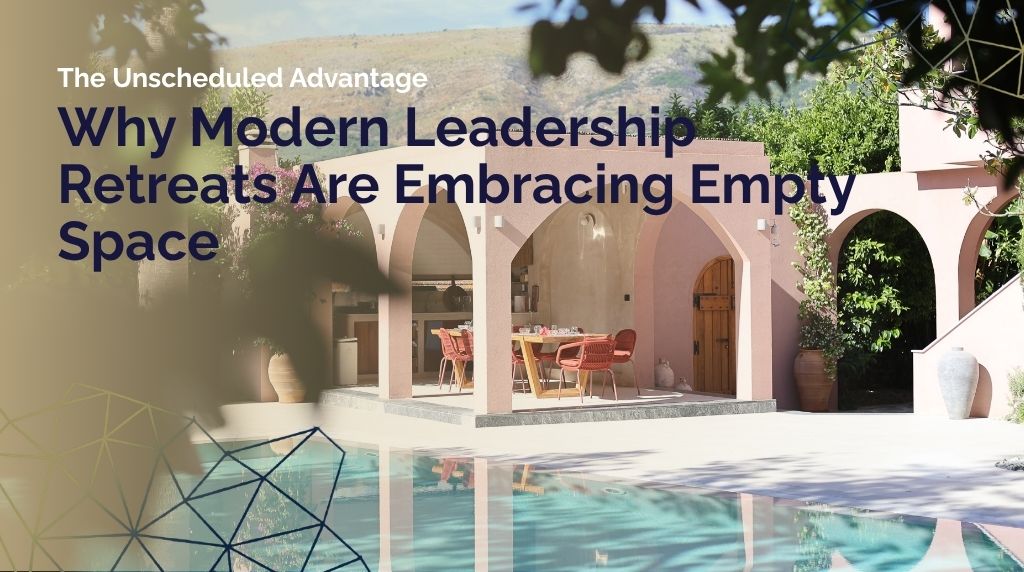
The Unscheduled Advantage: Why Modern Leadership Retreats Are Embracing Empty Space

Table of Contents

There is a quiet but significant shift occurring in the design of corporate offsites. The traditional model for leadership retreats—defined by back-to-back sessions, compulsory workshops, and an agenda maximized for ‘productivity’—is giving way to a more intentional approach. Organizations are discovering that the most profound breakthroughs do not happen during the fifth strategy session of the day. They happen over a quiet coffee, on a walk between venues, or during an unscheduled afternoon. This evolution recognizes a simple truth: for leaders to connect, reflect, and strategize effectively, they need something that over-scheduling eliminates: space.

Why Leadership Retreats Are Changing

The move toward less structured retreats is not a matter of preference; it is a strategic response to the changing nature of work and leadership itself. Several factors are driving this evolution.

First, a heightened awareness of executive burnout has forced a reconsideration of what ‘productive’ really means. A leadership team running on fumes cannot generate innovative ideas or build a resilient culture. A retreat that mirrors the relentless pace of the office is a wasted investment. Second, leadership expectations have changed. Modern leaders are expected to be empathetic, emotionally intelligent, and deeply connected to their teams. These qualities are not cultivated in a lecture hall but through shared experiences and genuine human interaction. Finally, in an era of distributed and hybrid work, the value of in-person connection has never been higher. A retreat is a rare opportunity to build the relational trust that virtual meetings cannot fully replicate. It is a time to strengthen the human infrastructure of the company.

Danielle Riddle Close Up

Insight from our CEO:

“The best retreats create enough structure for alignment and enough flexibility for real interaction.”

Try Our Elite Travel Management Service Fee Free For 3 Months

The Problem With Over-Scheduled Retreats

The ‘old’ model of leadership offsites was built on a flawed premise: that value is directly proportional to the number of scheduled activities. This approach often backfires, creating an environment that is counterproductive to the goals of a retreat.

  • Cognitive Overload: When leaders are shuttled from one complex session to another, their capacity to absorb information and think critically diminishes. The brain needs downtime to process new ideas and make connections. Without it, valuable insights are lost.
  • Social Exhaustion: Constant, structured interaction can be draining, especially for more introverted personalities. When people are socially fatigued, they withdraw, and the opportunity for authentic connection is missed.
  • Lack of Processing Time: A packed itinerary leaves no room for reflection. A leader might have a breakthrough idea during a morning session but has no time to explore it before being pushed into the next activity.
  • Performative Productivity: An over-scheduled agenda can encourage a culture of ‘performative productivity’, where leaders feel pressured to appear engaged and ‘on’ at all times, stifling vulnerability and honest conversation.

Why Unstructured Time Often Creates the Most Value

The true return on investment from a leadership retreat often comes from the moments that were never on the official agenda. Building pockets of unstructured time into the itinerary is a deliberate strategy to foster the conditions for these moments to occur.

Spontaneous conversations over lunch or during a walk can solve problems that formal meetings could not. Trust is built not through a scheduled icebreaker, but through shared laughter and discovering common interests. Creative thinking flourishes when the mind is relaxed and allowed to wander. It is in these quiet, unscheduled moments that leaders can have deeper reflections about their role, their team, and the future of the business.

What We Learned From Our Leadership Retreat in Greece

At Inspired Travel Group, we recently put this philosophy into practice during our own team retreat in Greece. Instead of filling every hour, we designed an experience that balanced structured objectives with the freedom to connect organically. The results were more powerful than any rigid agenda could have delivered.

Our days blended planned activities with ample leisure time. We had a memorable day sailing on a speed boat, but we also had entire afternoons open to explore a local village, trek down to a hidden beach, relax by the pool, or simply have a quiet conversation. Mornings were intentionally slow, allowing the team to start the day with clarity rather than rushing to the first item on a checklist. This improved everyone’s energy and engagement for the sessions that mattered most.

Crucially, our work sessions were designed to be impactful and finite. This created clear boundaries; when we were working, we were fully focused, and when we were ‘off’, we could completely disconnect. This structure enabled genuine relationship-building. The most meaningful moments happened outside the ‘boardroom’—sharing stories over a long dinner, navigating a new town together, and simply enjoying the stunning environment of the Greek isles.

The setting itself played a vital role. Removing the team from their daily environment and immersing them in a new, inspiring culture lowered barriers and encouraged a different kind of interaction. Managing the complex logistics of such an international trip—from flights and transfers to unique local experiences—is a significant undertaking, which is why companies rely on expert partners for their most important corporate retreats and offsites.

The Role of Pace in Executive Retreat Design

Designing a modern leadership retreat is an exercise in managing energy, not just time. The pace of the event dictates its emotional and psychological impact. An effective itinerary considers the natural ebb and flow of human energy, balancing periods of high-focus work with opportunities for rest and social connection.

This is particularly important for accommodating both introverts and extroverts. While extroverts may draw energy from group activities, introverts need solitude to recharge. A well-paced retreat offers a mix of mandatory group sessions and optional activities, giving individuals the autonomy to manage their own social energy. This prevents the ‘retreat fatigue’ that can set in by day two of an over-programmed event, ensuring that leaders remain engaged and present throughout.

Why the Best Retreats Feel Intentional, Not Exhausting

Ultimately, a successful leadership retreat should feel expansive, not exhausting. It should create emotional and mental space for leaders to reconnect with their purpose, their colleagues, and the company’s vision. This is achieved by prioritizing quality of interaction over quantity of activities.

The goal is to curate a series of meaningful experiences that foster connection and strategic clarity. This requires a shift in mindset—from filling a schedule to creating a framework for discovery. By embracing a slower, more intentional pace, companies can design group travel experiences that build a more resilient, connected, and sustainable leadership culture. All traveler itineraries and documents can be seamlessly organized in one place, like our Tripscape App, but the real magic happens in the space between the scheduled events.

Frequently Asked Questions

What is the main difference between old and modern leadership retreats?

The primary difference is a shift from maximizing scheduled time to maximizing connection and reflection. Old retreats featured packed, back-to-back agendas focused on information delivery. Modern retreats incorporate intentional downtime, flexible schedules, and experiential activities to foster deeper relationships, strategic thinking, and prevent burnout.

Why is unstructured time so important on a retreat?

Unstructured time allows for the spontaneous, informal conversations where true trust and rapport are built. It gives leaders the mental space to process information from formal sessions, think creatively, and have deeper, more authentic interactions than are possible in a structured workshop environment. The most valuable breakthroughs often happen in these unplanned moments.

How do you plan a retreat that isn't exhausting for introverts?

A successful retreat balances group engagement with opportunities for solitude. This can be achieved by making some activities optional, scheduling longer breaks between sessions, providing private accommodations, and choosing a location that is inspiring without being overstimulating. The goal is to allow individuals to manage their own social energy, ensuring they can be fully present for key moments.

What is the first step in planning a modern leadership retreat?

The first step is to define the 'why' before the 'what'. Instead of starting with an agenda, start by clarifying the core objectives. Is the goal to build trust in a new leadership team, solve a specific strategic problem, or reward top performers? Once the desired outcome is clear, you can design an itinerary and choose a location that creates the right environment to achieve it.

Final Thoughts

The evolution of leadership retreats reflects a deeper understanding of what drives high-performing teams: trust, psychological safety, and genuine connection. Creating an environment that fosters these qualities requires more than just booking flights and meeting rooms; it requires a thoughtful approach to programme design and operational excellence. For organizations looking to move beyond the constraints of the traditional, over-scheduled offsite, partnering with a specialist in full-service corporate retreat operations ensures that every detail—from the pace of the agenda to the on-the-ground experience—is intentionally crafted to achieve your strategic goals.

💡 Need help planning business trips? Work with a corporate travel agency that gets it. Inspired Travel Group handles every detail with expert care. Get Started Today!

Links to related Articles

Table of Contents

Corporate Travel Inquiry

1Your Information
2Business Information & Travel Expectations Heading
3Your Message To Inspired
Your Information

Request Corporate Trial

1Your Information
2Business Information & Travel Expectations Heading
3Your Message To Inspired
Your Information

For those that require a higher level of service

Corporate Travel Inquiry

Your Information
Business Information & Travel Expectations
Your Message to Inspired