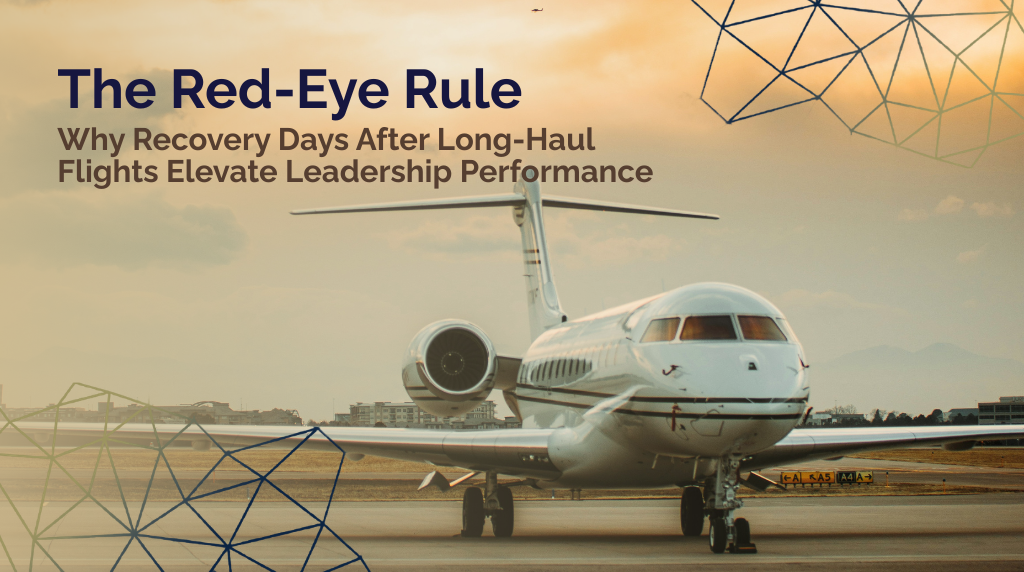

For senior leaders, the most critical business decisions are often made hours after landing. The practice of mandating recovery days after red-eye flights is not about providing a luxury perk; it is a strategic discipline designed to protect an organization’s most valuable asset: executive cognitive function. A leader arriving directly from an overnight flight to a high-stakes negotiation is operating at a significant deficit. This deficit impairs judgment, dulls critical thinking, and introduces unnecessary risk into key business outcomes. Establishing a formal recovery policy is a hallmark of a mature organization that prioritizes performance over the appearance of productivity.
💼 Want to Take the Stress Out of Business Travel?
👉 Get started with a dedicated corporate travel specialist today.
Overnight, or “red-eye,” flights are a staple of corporate travel for a clear reason: they maximize time. By travelling through the night, an executive can theoretically attend a full day of meetings in their home city, fly overnight, and arrive for a morning meeting in a new time zone without losing a business day. This efficiency, however, comes at a steep physiological cost. The pressure to minimize time out of the office often forces leaders to sacrifice the one resource that governs the quality of their work: restorative sleep. The consequences of this trade-off extend far beyond personal fatigue, directly impacting shareholder value and operational integrity.
Understanding the science behind travel fatigue reveals why a simple cup of coffee is an inadequate solution. The impact of a red-eye flight is a combination of sleep deprivation and circadian rhythm disruption, creating a potent cocktail for cognitive impairment.
Even in the relative comfort of a business class cabin, sleep on an aircraft is fragmented and of lower quality than sleep in a stationary bed. Research consistently shows that sleep deprivation leads to measurable declines in executive functions governed by the prefrontal cortex. These functions include:
Crossing multiple time zones desynchronizes the body’s internal clock from the new external environment. This ‘jet lag’ affects more than just sleep; it disrupts hormone regulation, digestion, and core body temperature. For a leader, this can manifest as mental fog, reduced concentration, and an inability to maintain presence during critical conversations. According to the Centers for Disease Control and Prevention, cognitive performance can decrease by 20% after 17 hours of wakefulness, an equivalent impairment to that of someone with a blood alcohol content of 0.05%.
Framing the recovery day as a strategic investment shifts the conversation from cost to value preservation. The expense of an extra hotel night is trivial compared to the potential cost of a poorly negotiated contract, a missed opportunity, or a damaged client relationship.
An effective recovery policy is not an informal suggestion; it is an operational standard supported by the company’s travel program. This requires a shift in how travel is planned and booked.
Instead of booking a flight to land at 6:00 AM for a 9:00 AM meeting, the policy should mandate booking a flight that arrives the evening before. This allows for a full night’s sleep in a hotel, enabling the executive to arrive at their meeting rested and fully prepared. For particularly demanding trips that cross many time zones, such as travel to Asia or Australia, a full 24-hour recovery period may be necessary.
This is where partnering with the right Corporate Travel Management firm is critical. A generic call centre or a self-serve booking tool is designed for transactions, not strategy. It will simply execute the request for the 6:00 AM arrival. A dedicated travel advisor, however, operates as a strategic partner. They understand the ‘why’ behind the Red-Eye Rule and will proactively recommend itineraries that build in recovery time. They can secure rooms for early check-in or late check-out and ensure seamless transfers, removing logistical friction so the leader can focus entirely on recuperation. This human-centric approach transforms a travel policy from a document into a lived reality.
For most domestic or transatlantic red-eye flights, arriving the evening before your first meeting allows for one full night of restorative sleep. For more strenuous travel involving a time difference of eight hours or more, a full 24-hour recovery period is advisable. The policy should be flexible enough to account for the intensity of the travel and the importance of the scheduled meetings.
Position the cost as risk mitigation. The expense of one hotel night is a fixed, predictable line item. The potential cost of a fatigued leader making a poor multi-million dollar decision, damaging a key relationship, or missing a critical detail in a contract is unquantifiable and far greater. It is an investment in the quality and integrity of your leadership's output.
While the primary focus is often on senior leadership due to the nature of their responsibilities, a tiered policy can be highly effective. The 'Red-Eye Rule' should be mandatory for executives and client-facing roles where peak performance upon arrival is non-negotiable. For other employees, it can be offered as a best practice or an option, promoting overall employee well-being and a healthier travel culture.
Unlike an online tool, a dedicated advisor understands your company's travel policy as a strategic document. They will proactively search for flight options that comply with the recovery rule, rather than just presenting the fastest or cheapest route. They provide counsel and structure itineraries that protect traveller well-being, turning a passive policy into an actively managed component of your travel programme.
Mandating recovery days after red-eye flights is a decisive move away from the hustle culture that dominates many industries. It is an acknowledgment that human capital, particularly at the leadership level, requires strategic protection. By investing in rest, organizations are not adding an expense; they are safeguarding the clarity, resilience, and high-calibre performance their leaders are paid to deliver. A truly effective corporate travel programme is not measured by its ability to book the cheapest, fastest flight, but by its ability to get the right people to the right place in the right condition to succeed. At Inspired Travel Group, our fixed-fee model and dedicated advisor service are built to support this philosophy, ensuring your travel programme enhances performance, not undermines it.
💡 Need help planning business trips? Work with a corporate travel agency that gets it. Inspired Travel Group handles every detail with expert care. Get Started Today!
